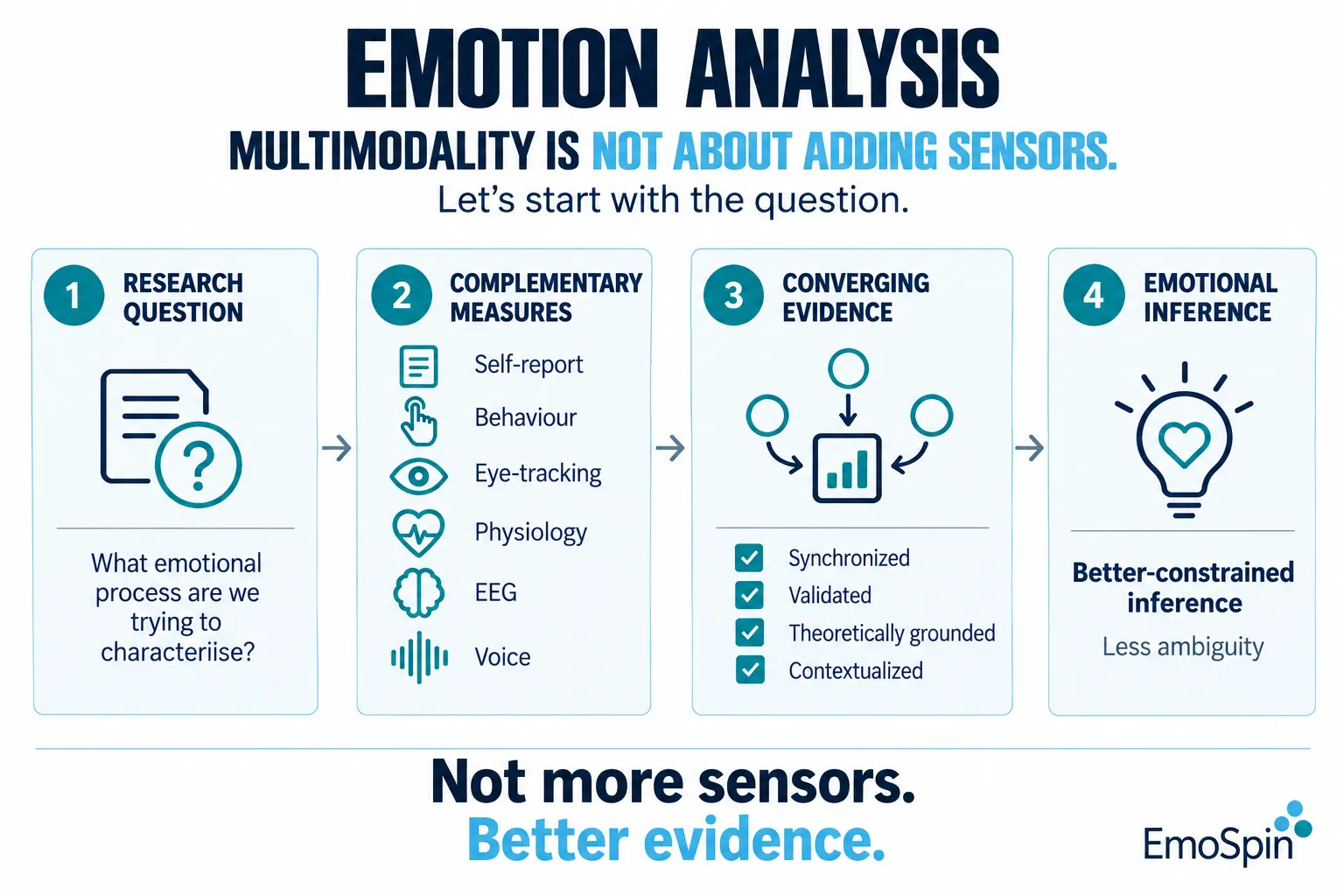
How to build an emotional interpretation
Emotion research relates subjective, expressive, behavioural and physiological observations to a question and an experimental context.
A signal leaves several interpretations open
An increase in electrodermal activity during use does not, alone, identify curiosity, pleasure, frustration or stress. Task, timing, baseline and other observations matter. Positive evaluation with approach suggests a different interpretation from negative evaluation with withdrawal; both require contextual scrutiny.
Define each measure’s contribution
Self-reports describe felt experience. Behavioural and expressive observations document responses. Physiological measures characterise changes relevant to a hypothesis. Disagreement may reveal different components, methodological limitations or questions requiring further investigation.
Convergence needs interpretation
Correlated outputs do not automatically provide independent confirmation. Examine what each captures and whether shared influences explain agreement. Reports distinguish observations, supported interpretations and mechanisms remaining hypothetical.
Related publications
- Roso A et al. (2024). Contribution of cosmetic ingredients and skin care textures to emotions. International Journal of Cosmetic Science, 46, 262–283.
DOI - Bouhout S, Aubert A, Vial F, Choquenet B (2023). Physiological benefits associated with facial skincare: Well-being from emotional perception to neuromodulation. International Journal of Cosmetic Science, 45, 458–469.
DOI
Tell us about your project
Describe the product or experience and the decision you need to make.
Contact our team